Showing posts with label India. Show all posts

Thursday, August 15, 2013

Independence Day, Happy or Somber?

Our forefathers might have put in their blood and sweat to free this country and its people from the clutches of tyranny, but would they be pleased to witness the shape and form Free India has taken? What would the Bhagat Singhs, Gandhis, Subhashchandra Boses of the revolutionary era have to say about our motherland today? Have we as a nation done justice to their struggles, have we been able to fulfill their dreams, have we actually broken free of the evils of colonial India? Are we failing the bright young faces of India, are we denying them a worthy future?

In some respects, I am sure they would feel proud of the progress this country has made. It has gone from being colonized to being taken notice of across the globe. It has carved its niche in many a fields and brought glory to the people. This country's citizens have made their presence felt in almost every country. But, are these people representative of the country as a whole? Have the issues of poverty, illiteracy, inequality actually been addressed? Does India Shining represent a certain section of the population or the whole country? Should we actually feel proud that our citizens are globe-trotting, making a name for their country; or should we look deeper into the reason behind them actually globe-trotting? It is very convenient to focus on the obvious positives of a country and take solace in that. But, it takes much more strength and conviction to face the negatives and try to look into them.

I know it is very easy to talk about the shortcomings of a country, but actually realizing that and working towards improving is a tough task. In the past year, there have been several occasions, where the country has stood together and tried to make themselves heard. And I feel respectful and proud of that fact. In some cases, the voices actually made a difference, and in others, they were simply ignored. What makes me happy is that people are ready to accept the failures of this country and try to find a solution. Whether or not this is a pragmatic approach that will get through to the people in power is a debatable issue. 

In light of these facts, there are certain issues that have cropped in recent times, that provoke me to think if I actually should be celebrating my country's Independence Day. I am not even sure if the common man in India, even feels like this is an event to be celebrated. And like them, there are some reasons, this Independence Day is a somber occasion for me:

1. Inhuman suppression of women: 
What happened in New Delhi last December is one of the most shameful pictures of India being painted. And it is not like, it was the first time women had encountered such a fate. But, the brutality of this incident was what sent shivers down everybody's spine. It was a rude awakening for the law enforcement authorities when their lack of action was brought to the forefront. It is also true that such incidents happen in other countries too, and it would be incorrect to judge Indian society by that. But, this incident brought to the forefront the appalling indifference of the community and police towards the triggers that lead to such events. The fact that we take the early signs lightly, and to add to that our movies glorify stalkers as eternal lovers, is not only disturbing but soul-shaking. This was one of the occasions where the voice of the people actually made some difference, in terms of faster and more conscientious actions from the authorities. Whether or not this is a matter that eventually gets lost among a pile of other old headlines is to be seen.

2. Increasing indifference: 
The dark hole we send our armed forces down
Is this some kind of cruel joke the country's leaders are playing with the men in green? How many more times do the men defending your country need to be tortured, insulted, debased before you actually take a stern step. The supposed leaders of this country have done nothing but bring shame to the families of these soldiers and made a complete fool out of themselves at the global level. And to add salt to the injury, there is not one, but two neighbors putting their foot in the door. We have had to deal with Chinese incursions this year and now the violations from Pakistan. Could you imagine America or any other other formidable country taking this like a sitting duck? Then why do we take this lightly? Again, it is heartening to know that people are taking notice of this injustice and trying to urge the leaders to come out of their slouch. But, we as a nation have to come out of our soft target image, and adopt an absolute zero-tolerance policy.

3. Inflation, bribery, power games, scandals: 
Seems like a line straight out of a mafia movie, but this is the state of our country that really worries me. With so many scandals uncovered and new ones cropping up every few days, the only thing that comes to my mind is that of the power hungry being ready to put at stake the common man. They don't care if their corruption or bribery costs some people their lives, or even the chance to earn a decent meal. With bribery, goes hand in hand inflation and the ever-increasing prices of basic commodities. It is easy to say that there is a growing middle class that can afford all this, but it fills me with pain to even think of how the lower classes might be surviving. How is it fair that we have India Shining on the one hand and India Drowning on the other? 

I know it is very easy for me to comment from a distance, and a lot of people would suggest that I show it in my actions rather than words. But, I have absolutely no clue as to how to bring order to this society. Are we doomed for inequalities? Is this what we are supposed to accept as our country's fate and let it pass? When I was younger, I thought the answer to this was to take action and bring about a change. But, looking at people like Durga, who tried to take a right step and was penalized for it, I no longer trust that actions of certain self-righteous people can transform this country. 


Although, the silver lining to all these issues is the fact that there is growing awareness and a need to bring about a change among the people. Having lived away from India for 4 years, I find utter respect for the masses who have made the effort and have attempted to bring about one small change at a time. It is not easy to be in the eye of the storm and still be capable of thinking straight, to find a solution. I don't know how strong of a voice the masses would have to present for the top tier to actually be scared and take necessary measures, but the attempt to stand by each other is a victory in my eyes. In the past, even the general public has ignored the signs of doomsday and moved on. The fact that they feel the need to protest is in itself a start. Whether the momentum is enough to get this country through true independence from these evils is something that only time can tell.

Monday, March 25, 2013

Harmonious Living: Empathy for animal life!

At the start of every movie, there is a disclaimer: "No animals were harmed while shooting this movie". And it makes me wonder if the disclaimer is there only because of the animal rights board or because of a conscientious crew. The chances of the first scenario are higher. There are very few people who actually care whether animals are hurt or not. There are few people who consider animals as equals, who deserve rights of their own. And although, the animal welfare board and animal rights commission have done a great job in increasing the awareness, it is just that: an awareness campaign. For something like preventing cruelty, it is empathy that is required. Awareness without empathy is like having a computer without the correct programmer. The computer will do what it is asked to, but if the programmer does not give the right direction, the computer can only perform pre-defined tasks. Similarly a society that runs in the fear of animal activists will do only what is required, but not think about what more can be done.

The Prevention of Cruelty to Animals Acts can direct people to protect the integrity of animals, but these acts cannot make people empathize and sympathize with animals. This is where animal welfare organizations come in. They do work under the preamble designed according to the Acts, but they go the extra mile in sensitizing the society towards the animal race. It is extremely pivotal that sensitization occurs at a young age, when there are no inherent biases in the cultivable mind. These organizations conduct awareness programs, but also bring the society, especially children in close quarters of the animals, in an attempt to reduce their inhibitions of animal contact. These organizations believe in the motto: "Today's aware child is tomorrow's responsible citizen!". By doing so, an opportunity is presented for people to experience the trauma of being an abused animal. Occasions like these stimulate the emotion centers in the brain and floods the person with a wave of responsibility and pro-activity. Especially if children try to be gentle to animals, it is difficult for parents and adults to let their children down. And so, there is promotion of the principles of the organization.


A post-operative hit and run case. 
One such organization is the Nagpur SPCA. SPCA is the Society for Prevention of Cruelty towards Animals and has multiple branches across India and the world. These branches are affiliated to the original Royal Society for Prevention of Cruelty towards Animals. I was born and brought up in Nagpur and thus, have witnessed the impactful work of Nagpur SPCA. The variety of ventures taken up by this society have been umpteen, ranging from releasing snakes from snake-charmers, tending for hit-and-run cases, rescuing wild animals, relief centers to tackle natural calamities (earthquake in Latur), running adoption campaigns for strays and many others. This society has not only worked for domesticated animals , but has ventured into the often unexplored realms of wildlife and has left no stone unturned in the attempt to preserve wildlife, at the same time, keeping citizens safe. 

A blind kitten being treated and housed at the animal shelter.
But, the most consequential problem that agitates the common man is of stray dogs, and that is one of the first things that needs to be tackled to generate empathy from people. If children are going to suffer from dog bites, contract infections from strays, nobody would ever want to work for the betterment of these animals. The Nagpur SPCA had realized this well ahead in time and accordingly, developed a long-term strategy to tackle with this ever-existent problem. These steps aim to uproot the main cause of disruption in the animal-human balance and create a more harmonious life for both races. 

It is important to realize that every issue has two sides to it. And as much as animal activists might want to promote the cause of animals, they have to acknowledge the fact that it cannot be at the cost of human life. It is this same thought that Nagpur SPCA has embedded in their task plan. If strays are inadvertently affecting the human population, the solution is not to send the animals to pounds and put an end to their life. f that were the case, every antisocial element in the society would be sentenced to death. We don't do that to people who behave like animals; then why the discrimination? Why not think logically and rise above barbarism? Why not think of animals as an indispensable part of the society? Once we do that, both races can thrive.

The solution suggested by Nagpur SPCA is to bring down the stray population and make them safe to be around. Strays do not crop up themselves. Most of the times, a stray locality is started by some dog owner no longer wanting to bear the responsibility and letting their dog out on the street. Once the dog is out, there is breeding and a litter of pups adds on to the stray population. If a few simple measures were adopted, the dog population would be cut down drastically and would present with a long term solution. But nobody wants to look at the big picture. People just want to take actions that will give them results then and there.

Stray puppies waiting to be adopted
It is creditable that this organization is trying to appease all members of the society by simple measures like Animal Birth Control (ABC) program, Anti-rabies vaccination for strays, Adoption campaigns, and  Awareness programs for the need to keep pets leashed. Under the ABC program, the organization plans to target different pockets of the city and procure as many strays in the area as possible, perform a castration surgery (sterilize the dogs), earmark the dogs for identification and release the dogs back to their locality. This method basically eliminates the chance of mating and prevents generation of fresh litter. It is also taken care that when the dogs are brought in, they are vaccinated against rabies (a fatal disease communicable to humans). At the same time, the organization is promoting adoption of stray pups, in a hope of reducing the stray numbers.

Strays peeking out of their rooms at the shelter.
Although, this is a rosy picture, the fact remains that all these ventures need a lot of infrastructure and money backing. The Municipal Corporation and government aid is able to support only so much; beyond a certain extent, the organization needs to rely on donations and external support. Support can be in any form: unwanted medicines, extra food, feeding bowls, etc. The local bakeries have been kind enough to provide SPCA with leftover crumbs rather than dispose them of. Sometimes, it is just a matter of knowing how to help. And if anybody would like to help, the administrators can be contacted for a visit to the animal shelter and hospital run by Nagpur SPCA, where the needs of the organization can be better gauged.

The measures adopted by SPCA have not only kept the menace of stray dogs at bay, it has also taken into account the existence of animals. They have not been fanatical about expecting people to take extreme measures for the protection of animals. Rational and feasible steps have been suggested. It is only for the community to take notice and contribute to a cause, which will, in the end, benefit the human race, without carrying the burden of bloodshed. This approach has been one of the hallmarks of this society and has helped in its successful establishment, presenting an acceptable image in the society. But, like all social causes, this needs financial support and emotional investment. A cause without emotional investment does not have ownership and without ownership, it is difficult to achieve goals. Goals that lead to the betterment of the society on the whole!

This blog post has been written for the National Social Venture Competition organized by iDiya.


Saturday, February 23, 2013

What would you do? : Spitsville

Life is full of choices. But the most important ones are where you have to identify right from wrong and pick a path. We come across such moments quite frequently in our daily routines, maybe some of us give it a thought, and then we move on to follow our busy schedules. This column is my attempt to reflect on such occasions and not let the sense of responsibility escape from me, on the pretext of a busy life. 

Also, this is where I would like my friends, and readers to share their thoughts and think out loud about their experiences. I am hoping to open up a discussion and do the right thing as a community.

So, here goes...

Spitsville:

Having grown up in India, "Gutkha Spit" was something that became part of the surroundings. As unhygienic as it was, I never saw the frequency of the spit marks go down. I remember corners of our apartment system lined by red streaks. Every other year the maintenance would paint the walls and within just a few weeks, the walls would return to their former glory, so to say. It was beyond my understanding what compulsive disorder people suffered from, unable to stop themselves from spoiling something pristine.

As I grew up, I got used to the fact that some things never change, the same thought a lot of Indians have grown up with. By the time I had my own independent thought process, there was nothing that used to annoy me more than people spitting all along the road, walking by. It had become part of their natural demeanor, and this with awareness signs all around. T.B used to be a deadly disease in India, and there was almost an epidemic of it. Given that, there were multiple public awareness programs, discouraging people against spitting, as that is the most common means of spreading the disease. Yet, people spit, they ignore their health and others' health. The "Chalta hai" attitude prevailed. I couldn't understand why nobody would stop these people.

And one fine day, on my way back from college, I just couldn't hold it in. I was riding my Dio, and the cyclist in front of me spit. I got ahead of him , and asked him why he had spit. He looked at me, with amusement, and said, "Aap pe gira kya (Did it land on you)?". As, I nodded my head in a "No", he was shocked to see me make an intervention, when it was supposedly none of my business. "Toh phir problem kya hai (So, what is your problem)?", said he in his defense.


So, my problem was that nobody thought it was their business. Why should I have had to be affected by it, before I can raise my voice? I tried explaining to him how spitting on the road is equivalent to spitting in his home. And he looked at me, like, I was crazy or something. But, one thing I did notice that he did not like to be cornered, and he quickly owned up, saying "Sorry". I drove away, but felt satisfied that I had at least conveyed that it is not okay to spit on the road. Maybe it was my naivety, that I thought it would change anything. But, today, 10 years later, I see things have improved a little bit. There are not as many red streaks along the walls of my apartment. And although, I do not know the reasons to this, I would like to believe that it was the voices of many people like me, that made things a little better, however little it maybe. 

Now, my question to you is, what would you have done in that situation? What would you do, today,  if you saw someone spit or throw trash on the streets? It is easy to expect everything to be clean and tidy, but who is going to do the dirty job, the dirty job of being loud and clear, of being stern and taking a stand "Sab kuch nahi chalta hai". I do not know if that person stopped spitting after that or not, but at least he spent those 2 minutes thinking about it. And sometimes, it just takes a thought to make you see between right and wrong. 

Have you had that moment? Have any of you had such an experience? Is it naive to expect one voice to change the society? Please share your thoughts!!


Saturday, January 26, 2013

A walk, poetry and some perspective!


The following article was published in the September 2012 issue of the magazine, Green Hope!

The world thinks that the greatness of America lies in the urban architectural structures and the modern skyscrapers. But, what people fail to perceive is that the steel and concrete just make a quarter of America’s beauty. The true beauty lies in the pockets of this huge country, where you feel most close to nature. Right in the arms of nature, surrounded by lakes, springs and critters, is how the true American likes to live. And not that, this was before urbanization. The suburb I moved to, is one that was recently developed, and yet there are no signs of excessive urbanization. You wake up to the merry chirp of birds, you see squirrels run on your deck (balcony), and rabbits nibbling on to nuts that fell in your backyard. The feeling of being so close to nature, without making an effort is unimaginable. Living with nature enclosing your daily routine is a marvelous sensation and unequaled by any other.

Walking around the lake, through a wooded trail, makes you feel this is where authors got their inspiration from. And the beauty of it lies in the fact that every season ushers in something new. It is the saplings and signs of new life that catch your eye in spring, whereas it is the lively activity of birds that fills summer. Autumn brings with it the iridescent colors and the preparation of birds ready to migrate. And the reason I am being able to describe all this is because nature is conserved the way it was supposed to be cherished. The advantages of being so close to natural wonders are manifold, one being, the appreciation for other lifer forms and the recognition that we all actually share resources. One of the thing that amazes me is the fact that the ducks, the loons, the turtles, rather than being scared of human activity, roam around unthreatened at all times. And that is only possible because there are no humans actually shooing or scaring the birds away, but rather minding their own business and going about their respective activities.

It is so common to see a raccoon, an otter, or a stork during your walk, that the need or the desire to visit a zoo is eliminated. It is so comforting to know that both the animals and humans here are so comfortable with each other, that neither side feels the need to interrupt with each other’s routines. Being around other species is not only a lesson in science for kids, but also teaches them profound lessons in sensitivity and respect for god’s creations. And once that realization has set in, it is easier to mold responsible citizens who are cognizant of the perils human ignorance could cause to the survival of other species. With so many ill-effects like global warming, depletion of resources, etc., it is vital to create a generation that is more aware of the needs of today for a harmonious tomorrow.

Witnessing the native bird and animal population in India dwindle because of ingesting plastic or incorrectly disposed medicines is heart-breaking. And it is small efforts like those made here, in terms of recycling, that help the native fauna sustain. The beauty of simply walking across a paddling of ducks is one of life’s taciturn moments. In such moments, the ease with which one can reflect upon the basic commonalities across different life forms is amazing. It is so heartening to witness the culmination of so many fellow human beings on just one bridge over the lake. The lake, the prairie grass that serves as an abode for the rich fauna, is just the perfect sanctum for a piebald community. You see photographers, artists, poets, nature-lovers and athletes enjoying the same view in varied ways. And then there are others who are just there for the sanctity, to soak in the view with a loved one. No matter, the agenda, all of them there have found a source to unwind. Only someone who has experienced the peace and the vivacity of nature together can perceive the importance of treasuring such spots.

What is striking is the fact that it is so easy to enjoy the simple pleasures of life, with small steps from us. The first step would be for appropriate garbage disposal and recycling. Throwing unwanted materials in the woods or the water will only result in an imbalance in the ecosystem caused due to either increased or decreased levels of a certain animal or bird population. That, of course, depending on the toxicity of the waste to the species in consideration. Another conscious effort from us could be to leave the flora and fauna as untouched as possible. That doesn’t mean not being outdoors in fear of trampling the grass, but just the realization that when you try to tamper a bird’s nest or a turtle cove, it is like someone shaking the walls of your house. It is very important for all members in an ecological niche to feel secure, for them to want to reside there. Some other measures that could be taken are to plant as many trees, grow lawns and have greenery to encourage a healthy food chain. If it were not for the grassy patches outside our apartment, I would never have had the privilege of watching a herd of deer wander into the apartment system, that too in the beautiful white snow.  It is spectacles like these that make you realize the importance of preserving the globe and it’s inhabitants in the purest form.

Imagine the beauty of a sunset with birds taking flight in the horizon, rather than just a plain sunset. Sometimes, all we need is a close conversation with nature to gain some perspective and it is but, what was meant to happen, before men came along and rearranged God’s scheme. It is said that one who loves nature, is never alone; and nothing else could be truer than that. I can only imagine what an effect a lack of landscape would have had on literature. Without the presence of awe-striking meadows, and mysterious woods, a William Wordsworth or Robert Frost could not have given the world, the mellifluous gems of their poetry.  And there would be no inspiration to remind the world of “the miles to go before I sleep”. Indeed, we are surrounded by miles and miles of natural beauty, it is for us to open our minds and preserve the milieu to enjoy a mutual existence.


Friday, August 17, 2012

Do I deserve to be free?


What vision did our forefathers possess?
What principles did our revolutionaries champion?
Do I remember those or are they a blur?
Do I then deserve to be free??

What does freedom mean to me?
What do I give in return?
Do I realize my responsibility or is it just a petty word?
Do I really deserve to be free?

Do I know the difference between my fundamental right,
and the wisdom to apply it as my fundamental duty?
Do I just exploit my freedom and ignore the duties?
Do I really deserve to be free?

Am I ignorant to my country's state?
Do I claim there is no reform needed?
Do I think I am just a spectator?
Why, then should I deserve to be free?

Do I celebrate my nation, infuse love for the country?
Do I accept my country with it's flaws and assets?
What do I do to turn the afflictions into ambrosia?
Can I really claim that I deserve to be free?

Do I pervade the vitality of knowledge,
Across barriers of poverty, injustice, corruption?
Do I believe in freedom of spirit?
If yes, then I deserve to be free...

Do I strive to obliterate all divides?
Economic, caste, creed, gender ?
Do I know that freedom is for all peoples, alike?
I ask myself, do I deserve to be free?

Do I turn a blind eye and deaf ear?
Do I wait for others to take charge, pretend there is nothing I can do?
Do I encourage others to shut their eyes too?
Do I then deserve to be free?

Am I perceptive to the hardships of our protectors?
Am I thankful for the sacrifices?
Do I show gratitude for the goodwill of some?
Only if I do, do I deserve to be free...

Do I make my country proud?
Do I wear a passionate shroud?
Am I the future our predecessors dreamed of?
Would they think I deserve to be free?

Do I preserve my culture?
And yet welcome diversity?
Am I the docile, yet feisty Indian, when need be?
Do I deserve to be free?

Do I propagate freedom of speech, expression?
Do I raise my voice against injustice?
Do I comprehend the power of the people?
Then I deserve to be free...

Do I take pride in my history?
Do I participate in making history?
Do I have huge dreams for my country's future?
Then I might deserve to be free?

Do I embrace the new meaning of freedom?
And propagate both technological and environmental freedom?
Do I comprehend the need for global freedom?
Do I really deserve to be free?

If I could answer in the affirmative for all of these,
If only I can claim to have impartially cheered for humanity,
If I can confirm to have exercised freedom astutely,
My ancestors would confidently say that I deserve to be FREE!


Tuesday, July 31, 2012

Ordinary men or Superheroes?

Exactly one year ago, I was traveling with my parents to New York, with a connecting flight from Atlanta. We had had a horrible start to the trip, with overnight delays and a detour to North Carolina, due to thunderstorms. So, we were nothing but relieved to reach Atlanta and get on track for New York. When we alighted from the flight and walked through our gate, it really did feel like an achievement to have finally reached half way through to our trip, after two long days. As soon as we started walking, we saw a big crowd at the terminal, loud cheering and clapping. And we were quite taken aback, to say the least. I mean all the passengers on board our flight had had a rough night, but how would have these other people known?One look back, and I realized what the applause was for. There was a big group of young soldiers, possibly returning from foreign postings, and here were complete strangers who were cheering for them. We could hear the words "Welcome Home", "Salute to you, Soldier", and "America is proud of you"! My father was quite surprised to see this and just said, "Why can't we honor our soldiers like them?".

Of course, we went on to have a long discussion over it, and we realized that even though Americans despise their country going at war, as much as Indians do, they do not lose appreciation for their countrymen. They do not undermine the fact that it is these young men and women, who did not chose to participate in war, but had to follow orders. People who chose to make a career in armed forces do so, to protect their country and fellow citizens, not to inflict atrocity on others. So, why is is that a country like India forgets a major war, like Kargil and its uncountable heroes? The war, like any other, was unnecessary and brought on by factors, best, not discussed here.

But, the fact remains that it is this militia that saved a lot of civilian lives from being targeted by the infiltrators. It is easy for people to debate over why wars happen, why can't we leave peacefully, etc. But, what is so difficult about remembering the sacrifices made by so many? For whatever reason, wars and violence are part of human nature. Then, it becomes equally important for people to value the handful who risk their lives, knowing well that one day they would be involved in something as complicated as war. The reason I say, it is complicated is because there are so many angles to killing the enemy, than just sending a bullet through another person. The question that always comes up in my mind is 'Can any training in the world actually prepare you to shoot another fellow human being?'. You can be trained to be strong, physically; possess endurance and skill, intelligence and alertness. But, can you actually be trained to be guilt-free and emotionless?

I have some friends in the armed forces, and I wish they never have to make that decision of whether to listen to their heart or follow their orders. I cannot even imagine what it must feel like to be faced with a combat, and actually having to use ammunition on a live person, for the first time. Because they are just like us, people who like pleasant things in life, who want to cherish the small joys and who want to be with their loved ones. They feel pain and pleasure the same way we do. Then how are they expected to transform from being movie buffs, cricket lovers and jolly personalities to protectors of the nation overnight? How are they expected to carry the burden of leading so many men, and protecting several others? Of course, they are trained and they know what they were getting into in the first place. But, can you actually prepare someone to walk away from their wounded buddy (as they are called in Army Lingo) and put the mission on a higher pedestal? How can you train their mind to be untouched by emotion and keep going? How can they find the courage to walk in the line of fire? How is it possible to keep your anger aside, forget the way your fellow soldiers were treated and yet, treat the enemy's fallen with respect? What are these men made of?

All these unsettling thoughts bother me every time I watch a war movie. The Kargil War was an important landmark in Indian history, and it was necessary for our generation to understand that freedom does come at a price. The ailment of Independent India is that people have taken their freedom for granted and refuse to hold responsibility for anything. This war was a good reminder that a few chose to put the country and the lives of others above their own. As grateful citizens, the least we can do is to remember the valor and sacrifices made by these men and their families. It also means, that we do our bit and contribute to our country's progress and improvement, in every way we can. It could mean picking up garbage from the streets, minimizing child abuse or promoting literacy. Because it is for the country's future that these soldiers defend it from enemies. If we cannot secure a decent future for the country, their effort to defend the country goes waste.

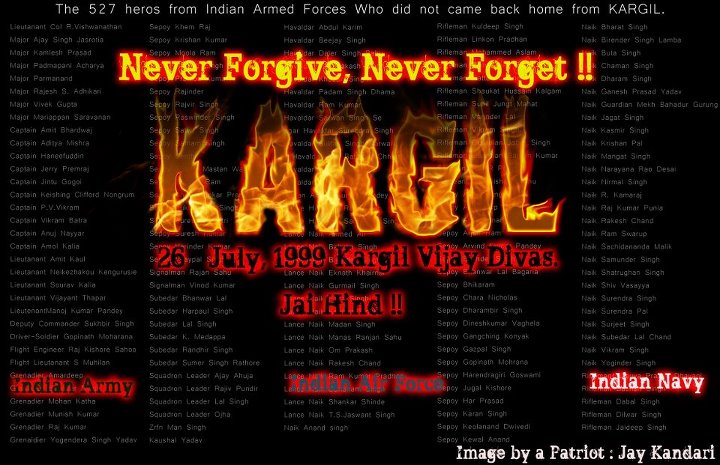
The Kargil War had a casualty figure of 527 Indian soldiers and that is a huge number for a senselessly instigated war. We have to realize that there were a lot of soldiers in their early twenties who were juxtaposed into the war scene, having just received their first posting. I am not sure if experience helps and prepares you for war, but definitely the rush of youth could blind you and could you catch you unawares. Since, this war was largely covered by the media, there were multiple stories of engagements being called off, marriage plans postponed, and what not. Whether it was fair to have personal details of these soldiers being discussed, is a debatable topic. But, what I think it did, was give a face and a name to the unknown soldier. The war cry devised by Capt. Vikram Batra, "Yeh Dil Maange More!" is etched in our memories forever. What happens is, everybody knows a war is being fought, they mourn for the martyrs and eventually forget about it. But when there is a name attached and a story to tell, there is a personal connection. It becomes easier to identify with the person and then it becomes a personal loss. It is important to sense that feeling, because then the war means much more and hits home. 

Since this war was a highly televised one, the public became aware of the sacrifices these men were making; some even having to call off their weddings. It became evident that these men were overcoming huge personal losses and yet, braving the enemy. I knew then, that it must be tough to survive the extreme cold, but only when  I moved to a place with temperatures of -50C, that I developed a new-found respect for these men. It is torturous even to stand outside, with the biting wind, leave alone, get into a hike. It is thanks to the electronic media, who familiarized the public with the treacherous terrain and the dizzying altitude. The daily updates also introduced us to the lives of these soldiers in the face of extreme conditions, be it the tight rationing of food supplies, the unbearable cold or the lack of entertainment. It was also the acknowledgement that at such times, small joys meant a lot, and receiving letters from complete strangers was definitely among them. 

It has been 13 years and a lot of people have forgotten these heroes and their families. We have to remember that putting up names on marble memorials is not enough. Every once in a while showing gratitude and honoring these soldiers is important. For us, 527 is just a number, but for the families, it is 527 brothers, sons, fathers, husbands lost. And that is not something they can forget. So, why should we? After all,we were saved the trouble of defending ourselves, because of their acts of courage. To all the Vikram Batras, Saurabh Kalias, Anuj Nayyars, Vijayant Thapars and many unnamed heroes, 'We remember you, we are proud of you, we salute you and we appreciate your efforts and we are here because of you'! And to all the countrymen, who have forgotten the Kargil War and its heroes, who remember the 1999 World Cup more than the War, here is a rude reminder; it is not Sachin Tendulkar, but these soldiers who won us the bigger battle. It was disheartening to know that when today's youth were interviewed on Vijay Diwas, they had no clue whatsoever, of these war heroes, but were well acquainted with cricketers, celebrities, etc. I have challenged myself to pay tribute to all war heroes on this Vijay Diwas and find out more about the 527 men who lost their lives protecting our beautiful country and no longer let them be 'The Unknown Soldier'. How will you pay tribute?

Some resources that helped me find more about the fallen heroes and the stark reality of war:


Thursday, April 26, 2012

Welcome to the family!

Photo courtesy: 80thbirthdaypartyideas.org

It was my maternal grandfather's 80th birthday, and the whole of my mother's side of the family was there, people I was meeting after 10 years and some I was meeting for the first time. There were my mother's first cousins, second cousins, even my grandfather's first cousins and their grandchildren and by then, I had lost track of who was who. There were so many introduction sessions going around at my Mama's place, it almost felt like it was the first day of college and all the classmates were being acquainted. Never had I seen such a huge crowd together, where there were so many unfamiliar faces, yet we were supposed to be family. My grandfather seemed very very pleased to be reviving lots of childhood memories with his siblings and cousins. 

And all of his children and grandchildren were busy being perfect hosts to all the relatives who were going to stay with us. We were going over sheets of papers, the adults over what menu was decided for what occasion and the younger generation over the entertainment part of the evening. There were going to be lots of people, all our relatives, my grandfather's friends and colleagues, some of his students, and basically anybody who knew him well.

The day of the celebration, a small "Pooja" was organized, and everybody participated in it. The evening was set for more fun things like a song and dance performance by all the grandkids; the youngest grandson reciting a verse from Gita as taught to him by our grandfather and what not. The most interesting part of the evening was when we had planned a quiz based in trivia related to our grandfather, like "Who was his favorite actress, what was his first school?". It was hilarious to see the audience guessing answers about who his favorite actress was, some saying "Madhubala:, others guessing "Nargis"; and finally when the answer was declared to be "Deepika Padukone", a cumulative sigh was heard from everyone.

Photo courtesy:  www.mansibhatia.com/2010/10/perfect
Now, during all this excitement, there was one person sitting in a corner of the room, feeling a little shy, a little left-out, a little intimidated. He was not sure why he was there. Of course, he was there to convey his wishes to this wonderful man, but he was not even related and he could have given anything to run away for a bit, and get some air. He fidgeted with the gift in his hand, in the process spoiling the elegant gift-wrap. He looked around the room, his eyes following the few familiar faces he knew, and trying to meet eyes with them. His eyes finally met the eyes of one person he felt comfortable with and felt a little calm, after receiving a smile from that person. But, very soon this person got busy with the duty assigned to them, and again he felt lost.

Soon enough, the evening came to an end, and everybody headed towards the dining area. This is when, I walked over to this person and tried to make him feel comfortable. I chatted about regular stuff, like the weather, how his family was, and other common topics. I was quickly joined by all my younger cousins and my sister's in-laws, and they tried joining in to the conversation too. But you know how it gets, when cousins are around, we tend to ignore everybody around and talk in our own secret codes, bickering about stuff, giggling over apparently funny things, which seem completely normal to the rest of the world. We did try involving this person in our chat, but it was his first time being around this group and naturally, took time to warm up. 

Photo courtesy: americanancestors.info
Just as he was getting a little settled in this company, with all of my guy cousins talking about video games and action flicks, to his horror, he was being ushered into a crowd of adults, being introduced to all of them. And as Indian culture goes, very soon, he was seen bending down a hundred times to touch their feet. This person was my then husband-to-be and it was his first time being introduced to the family. Ours being a love marriage, and both of us coming from opposite corners of the country, with huge cultural differences, we always knew meeting the families was going to be a challenge and making room for ourselves in each other's families a huge step out of our comfort zones. And today was the day of the verdict.

Of course, he had met all my cousins, and aunts and uncles, but today was the fateful day when he met our extended family. He had said he would be fine meeting them, but I guess, what he hadn't anticipated was, how large this extended family could be.  It was like he was the star performer of the evening. Everybody wanted a piece of him, to scrutinize him and get a chance to know what he was like. He looked like a fish out of water, considering the fact that his was a pretty small family and this was the first time he even came to know of how many possible relations there could be. Fortunately my parents were with him all the time, and signaled one of my cousins to come and get him, when they thought he had gone through enough. 

As soon as he saw all of us, the poor thing literally slumped into the chair in front of him. Me and my cousins tried being decent, but there was no way we could have stifled our laugh. looking at his puppy dog face. The jolly man that my husband is, he eyed us for a minute and broke into laughter too. He muttered, "I am glad some of your relatives are based abroad, otherwise with them, I am sure your family would be equivalent of a kingdom  in itself"!

Till date, everybody in the family talks about that day and appreciates his courage to face such a huge family. "I am surprised he was not scared away by that meeting" says my grandfather. "But the fact that he was able to hold his own and get all our relatives to like him, is testimony of his character and assurance that he can survive in this huge family". It sure was, today my husband has bonded so well with everybody in my family; that of course, if you ignore the part where he still does not remember their names! For that part, we might have to look elsewhere  for help organizing the family tree!

This entry is a part of the contest at BlogAdda.com in association with imlee.com

Friday, February 3, 2012

The India of my dreams

You grow up in a country, you have seen things change and have grown along with the changes. Then, you move out of that place, and on your return, what you notice, sometimes takes you by surprise. That is what happens to me every year. Only a year passes by between my visits, and yet each time, I feel like I have stagnated, but my country is growing and taking huge strides. And it is so true, that distance nurtures fondness, whether it is for a place or a person. Sometimes, just taking a step back, helps you to notice what was right in front of you all along. I experience that every time I am back home, I get a completely new perspective of things and wonder how I hadn't appreciated these things before.

If asked, what two things I absolutely love about my country, it would be an impossible task to write those down. There are uncountable things that I love and admire about this great nation, but here are two that in recent times, have struck me as remarkable.

1. Smart enough to be flexible


The adaptability of this huge nation just amazes me every time I am here. It really is true, whether be it technology, fashion trends or education, India is always open to change. The pace at which the telecom industry is spreading its wings is unbelievable. Every household, these days, has at least two mobile phones. And given the fact that, the cell phone industry is undergoing such a revolution, India is not far behind in adopting those developments. Every urbane professional today aims to pocket a smart phone, even though the facilities like 'maps' might not be as useful. The widespread use of Facebook and Twitter in a country where the neighborhood gossiper keeps chattering about updates around the locality, the city and the world is just amusing. The extent of awareness about global trends is so much, so that even a small "chat" vendor has a sign put up with the option of "liking" his stall and account on Facebook. It might seem ridiculous at times, but to me, it is a sign of the willingness to absorb new technology. It is due to the same attitude that our professionals are doing so well in countries like USA and UK, where English is the essential language of communication. It is because our policy makers were smart enough to ensure that it's country men shouldn't lose a chance at proving their worth, just because of the lack of fluency in a language. As opposed to China, whose people are equally hard-working, Indians had the upper-hand of  being able to fulfill the basic requirement of communication. It fills me with pride to see that India knows it's strength and also knows where and how it needs to fill the holes, so that the world takes notice of it's mettle. The number of people wearing sweatshirts, with logos of American Universities, is an indicator of our presence on the education scene. I am sure this innate Indian flexibility will definitely take India to newer heights.

2. Who needs a GPS?
It is a well known fact that a GPS would not work in India as well, as it does in Western countries. The reason being, the small lanes and in-roads, which do not even show up on the GPS. But, the bigger question here is, does India need a GPS? The fact that you could just stop someone and ask them for directions, eliminates the need for a GPS. Add to that, ten people who would be more than willing to show you the way. And everybody trying to think about the shortest way, taking in consideration closed areas due to construction changes on the road. Could a GPS take into account these dynamic changes? I love the fact that in India, the people connection is as good as the network connection. If you are in need, all it takes is a phone call to a friend, who calls another friend, who calls another friend, and eventually you are helped by a friend's friend's friend. I think this concept exists only in India - we never have acquaintances, we only have friends. A look at our Facebook friends list, and you would know, that anybody we even spoke for 5 minutes becomes our friend. And it is this connection, that is one of our biggest strengths. While putting our car in reverse gear (or backing up), we don't feel the need of the rear-view mirror, because we have people around, guiding us on how much to back up, constantly saying "Aan do, aan do". I love that we rely more on humans than on machines, because finally, it is a human who can understand best what another human needs.

As, I had said, I could go on about what I love about India, but there are also sore points, that we might not like to talk a lot about, but have to accept them. We have to realize that if we want our country to change and improve, the first step would be to realize and accept the shortcomings. So, here come:

1. Breaking barriers


The economic disparity between the rich and the poor has been a classic problem in many countries around the world. And of course, India is not untouched by that. But, what makes this difference worse is that, the disparity between the rich and poor, soon transcends into a disparity between the educated and uneducated. Money should not control the ability of a person to be literate, but it does. And the condition is getting worse. On the one hand, we feel proud about our country producing intellectuals. As I just said above, we feel proud that our good education and fluency in English have helped us make a place for ourselves in the world. But, what percentage of the Indian population does that section form? There is still a huge percentage of the population, where children have never been to a school, they have never known the pleasure of reading a book, just because their parents cannot afford to send them to a school. Although, the "Sarva Shiksha Abhiyaan" tried making an effort, the ignorance towards smaller villages is unbelievable. And the fact, that these campaigns pick up momentum only from election to election is disheartening. The policy makers should realize that the "Right to Education" is a very pertinent right in today's world, and instead of having reservations here and there, there should only be special privileges for the worthy, but financially weak section. Our education system has paved way for the country's success, but it is the same education system that discriminates and might design the downfall too.

2. Taking responsibility
On the same lines as above, it is amazing to see how many Indian students and working professionals are placed outside of India. All these people take pride in being in such developed countries and don't hesitate even for a second, before showering praises on the quality of life and living conditions in these countries. The irony is that we are aware enough to notice what the benefits are, but not proactive enough to implement them. There are so many NRIs today, who visit India, or just students coming back home, yet they don't try to bring back what they noticed and admired about these developed countries. I do realize, that one man's actions cannot change the universe, in a second. But, there is a chance, that these actions might start a chain reaction and there might be substantial results. I detest the fact that people will be careful about cleanliness in USA, UK, but those same people, when back in India, start treating the roads as a garbage disposal. You can't just crib about the system, without trying to do your bit. If you can't change, yourself, how is the system going to change? Are we not part of the system? It hurts to hear people talk about the systematic traffic and strict traffic rules abroad, but not even wanting to use the vehicle's indicator, while making turns in India. If you have got the opportunity to learn the good points about a country, have the commitment to bring it back to your country. Looking into the number if people that are studying or working outside of India, if each one tried to implement one positive, the change in India would be visible. Your country made you capable enough to sail the seven seas, now it is your chance to give back to the country in your small way.

When every citizen is conscientious enough to realize what the strengths and weaknesses of our country are, when he/she is dynamic enough to think of ways to make our strengths outdo our weaknesses, what will arise is the "India of our dreams". 

Tuesday, February 22, 2011

What's with Indians and 'foreigners'???

The other day me and my husband were enjoying 'bhel puri" and other tempting Indian snacks, when we saw an American couple come in to try some Indian food. They had been to this restaurant before too, but for lunch buffets, so this was their first time where they had to pick and chose for themselves. So, they requested for whatever best they could gauge from the descriptions. Now, the biggest question for them, when the food came in, was to decide how to eat the food. What went with what??? The owner there was kind enough to demonstrate as to what should be eaten how.

I was pretty happy to see them helped, because that is how I would want to be treated if I was in  their place. But, then the following sequence of events bothered me. The helper went out of his way, to get them extra plates, spoons and everything else. He was literally at their beck and call, whereas the policy there is that you have to get up and get everything you need yourself. So why the exception???

What I did not understand was whether it was out of kindness or this undying will, a lot of  Indians have, to please 'foreigners' (thats how they are known back in India). If it was an act of kindness, it is good to see people helping others. But, the fact that the other customers were completely ignored, showed me that it was something more than kindness.

It is amazing how history has an effect on so many things. For a long time, we knew of Western countries to be developed and thought of ourselves as underdeveloped, or in recent years, developing. So, many many years back, we thought of Westerners to be privileged and those in contact with them, automatically gained a place of importance. But, so many things have changed since then. India is leading the race for development, Indians are doing well world over and have made a name for themselves in fields of intellect, art, creativity and every other field you could think of. Then why do we still feel the need to get approved?

There have been so many times in India, when I see 'foreigners', as they are known in India, being given extra attention. I mean just this time, when I was on my way back from India, I saw some Kiwis on the airport, ready to go back home, after following their cricket team all over India. And the way they were offered free coffee and stuff just shocked me. I was almost ready to go upto the coffee vendor and ask what I had done wrong, not to deserve free coffee. But I already knew the answer.

So why do we really have that urge to impress Westerners??? If we were just making them comfortable, that would speak about our hospitality, but bending over backwards for them would just say that we are spineless.

And if it is about being foreigners being treated favorably, then we, as non-Americans would be foreigners in the USA and we are never treated with extra attention. I never see any Americans running around, to get us a cup of coffee, or to please us with their behavior. The thought itself is hilarious, to imagine Westerners feeling the need to impress us. And if you go by the dictionary meaning, we definitely are foreigners, people from a foreign land.

Then what is the difference? There is one bright possibility that Americans have gotten so used to seeing so many Indians, that they no longer consider as foreigners. But, I don't think even when there weren't many Indians here, we were given privileges. So, why can't people in India do the same? Why are we still so amused when we see Western tourists in India? It has a lot to do with history and the stereotype portrayals, I think.

India was oppressed by Western countries for a long time and even later we did not have a voice on the global map, until recently. Those conditions made us strive harder to prove to the world our capabilities. Everybody was working hard to earn a good name for their motherland and somehow, we needed the approval of the big guns, as they were known then.

What we need to accept and understand is that, it is a new era now. Everybody knows India for the great success stories and exemplary achievers. We have proven our worth globally and made the world take notice of us in a big way. Then what are we waiting for? Why are we still stuck with the age-old notions?? I say, we should shake those feelings out, and realize our worth. Being hospitable and having no self-respect are two very different things. Indians are known for their hospitality, so we should stick to that, but anything beyond that is sheer ignorance to the fact India has proved it's mettle. This fact itself is impressive and we should not be required to impress anyone else. Isn't the new age about treating everyone equally? Globalization in it's true sense will take form, when there would be no such thing as foreigners due to the high numbers of cross-overs. That is the day I look forward to, where nobody needs to impress anybody and everybody is just paid the due acknowledgment, for forwarding the cause of humanity!
Related Posts Plugin for WordPress, Blogger...